
Sheepshead Identification in Southwest Florida
Sheepshead identification starts with a few visible features: a deep, silvery body, dark vertical bars, a blunt head, and unusually prominent teeth. Together, these marks can help you recognize a fish brought aboard near Cape Coral, Sanibel, or Captiva.
Whether you're learning about local fish before your first charter or hoping to recognize a catch on your next trip, knowing what to look for adds another dimension to the experience. Start with the body, then look more closely at the head and mouth.
Recognize the Sheepshead's Body and Bars
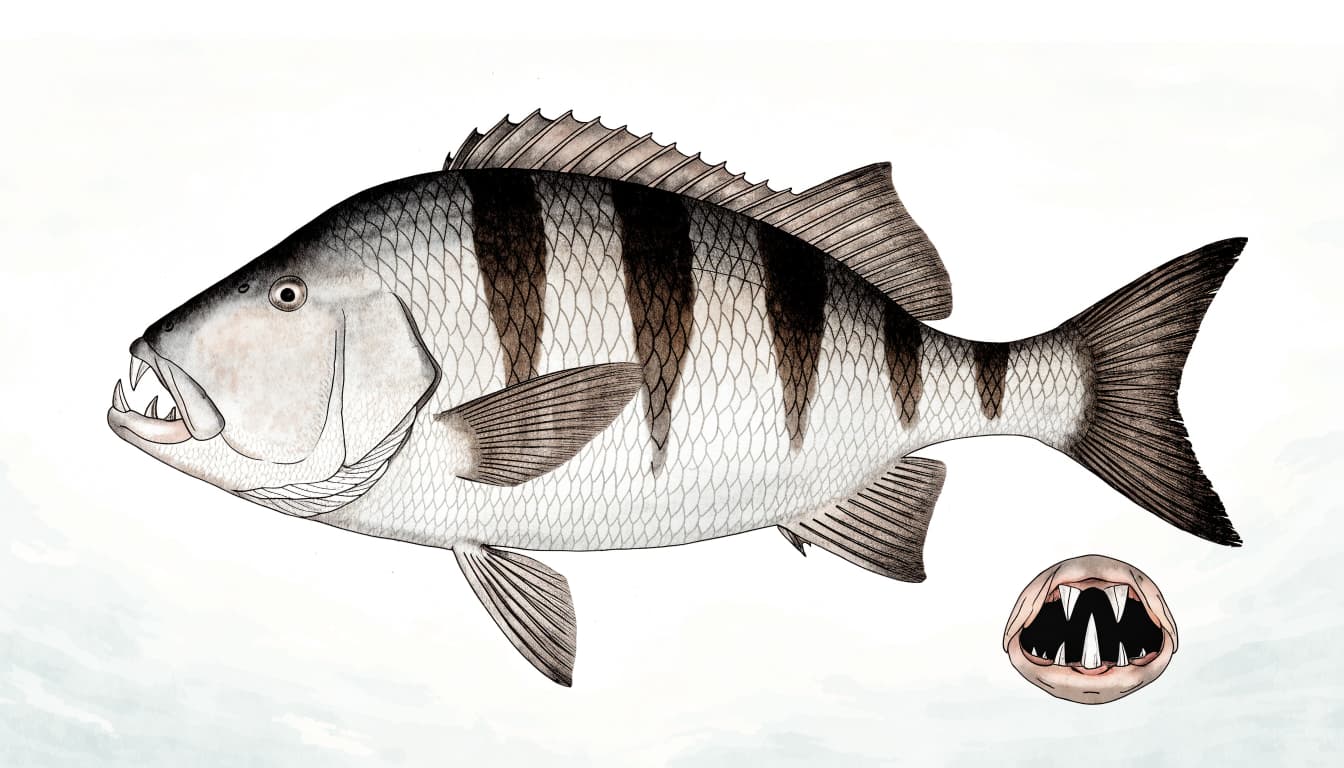
A sheepshead has a pale gray or silvery body crossed by dark vertical bars . Its outline is deep and compressed, so the fish looks broad when viewed from the side and relatively narrow when viewed head-on.
The bars are often the first feature you notice, but they are most useful when considered alongside the body shape and head. Other local fish can have vertical markings, too.
Look at the Direction of the Markings
On a sheepshead, the dark bars run down the sides rather than along the length of the body. They contrast with the lighter background, although their appearance can change with lighting, water conditions, and the fish's position.
If you see a fish at an angle underwater, wait for a clearer side view before settling on an identification. Reflections and shadows can make the pattern harder to interpret.
Notice the Head and Fins
The head has a blunt profile, with a small mouth compared with the depth of the body. The dorsal fin along the back has strong, sharp spines, another feature to keep in mind when a fish comes aboard.
The Florida Fish and Wildlife Conservation Commission's sheepshead profile describes the bars, teeth, and other identifying characteristics. Those details are most useful when you can see several of them together.
Take a Closer Look at the Teeth
The sheepshead's teeth are one of its most recognizable features. They are also a reason to keep your fingers away from the mouth and let your captain assist with handling.
Recognize the Front Teeth
At the front of the mouth, sheepshead have prominent incisors that can look surprisingly similar to human teeth. If the mouth is visible, these teeth offer a helpful clue alongside the striped body.
You don't need to open a fish's mouth to identify it. A view of the head, body, and markings is often enough to start a useful conversation with your captain.
Understand the Crushing Teeth
Farther back, sheepshead have molars and rounded grinding teeth. These are suited to crushing hard-shelled food, a useful adaptation for a fish associated with oyster bars and other coastal structure.
The Florida Museum's sheepshead species profile offers more detail about this fish, known scientifically as Archosargus probatocephalus. Its teeth are distinctive, but they should be observed without putting your hands near the jaws.
Compare Sheepshead With Similar Local Fish
A striped fish near a bridge or oyster bar may catch your attention, but the pattern alone doesn't settle its identity. Look at the chin, mouth, and overall outline before deciding what you've caught.
Juvenile Black Drum
Young black drum can have dark vertical bars, and the FWC's black drum profile notes their resemblance to sheepshead and spadefish. This similarity can make a quick glance misleading.
A useful detail is the lower jaw. Black drum have chin barbels, small whisker-like projections, while sheepshead don't have barbels on the lower jaw. The sheepshead's prominent front teeth provide another feature to consider if they are visible.
Ask your captain to help examine the fish rather than reaching around its mouth. A careful side view and a look beneath the chin can make the comparison easier.
Atlantic Spadefish
Atlantic spadefish also have a silvery body and dark vertical bands. Their deep, compressed shape can resemble a sheepshead when viewed briefly in the water.
Look at the overall silhouette as well as the stripes. Spadefish have a more disk-like outline and long portions of the dorsal and anal fins, while a sheepshead has a more oval profile and a blunt head. The Florida Museum's Atlantic spadefish profile provides another reference for comparison.
Redfish and Snook
Redfish and snook offer different markings to look for on an inshore trip. Redfish often have a copper color and a dark spot near the tail, while snook are recognizable by the dark lateral line running along the side.
Neither fish should be identified by color alone. Water and light can change how a catch appears, so take in its shape and markings together.
Find the Coastal Habitat Sheepshead Use
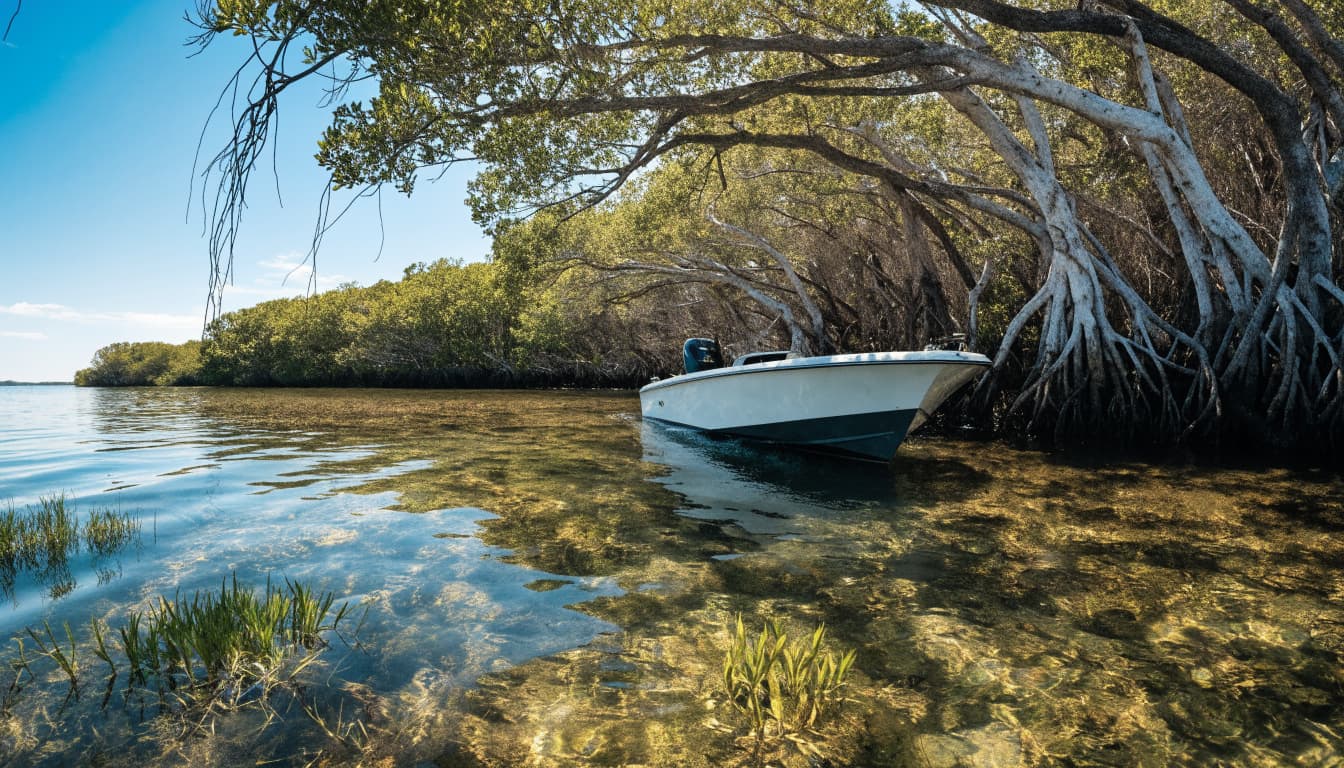
Knowing where sheepshead live gives you context for what you may see on a charter. Habitat can narrow the possibilities, though it cannot identify a fish on its own.
Explore Bays and Estuaries
Sheepshead use bays, estuaries, tidal creeks, and brackish river mouths. Oyster bars are among the places where anglers may encounter them.
Around Cape Coral, Sanibel, and Captiva, these connected waters offer a variety of settings for an inshore trip. Pine Island Sound, between Pine Island and the barrier islands, includes oyster habitat, seagrass, and mangrove edges.
Our bay fishing charters explore this broader network of bays and estuaries. The fishing area depends on conditions and your group's interests.
Look Around Coastal Structure
Bridge pilings, piers, channel markers, and buoys are also associated with sheepshead. These features give you recognizable places to look as you learn how local fish use the coast.
Sheepshead may be encountered inside the barrier islands or around nearshore structure in the Gulf. On a nearshore fishing trip, open-water conditions can feel different from those in a more sheltered bay.
Identify a Fish Before It Comes Aboard
A fish moving near the boat may be difficult to identify, especially when glare or rippled water changes your view. Give yourself time to observe it instead of relying on the first flash of silver.
Start with the broad outline. If the fish turns sideways, look for a deep body and dark bars that run down its flanks. A long, narrow fish with a dark line along its side suggests a different set of features.
Next, look toward the head if the water is clear enough. The blunt profile may be visible before the teeth are, while the chin can be difficult to see until the fish is closer.
If you are fishing with children or new anglers, invite them to describe what they notice. Body shape, stripe direction, and head shape are useful observations even when the fish turns out to be another species.
Handle a Sheepshead With Care
Identification continues after a fish reaches the boat, but its sharp dorsal spines and strong jaws make careful handling important. Follow your captain's direction and keep the fish supported during any necessary handling.
Keep Hands Clear of Spines and Teeth
The dorsal spines can puncture skin, and the fish's teeth can cause injury. Don't put fingers into its mouth or grab across the raised spines to get a closer look.
If a hook needs to be removed, let your captain guide the process. A brief view of the fish's side is more useful than struggling to position it for a photograph.
Make Release a Short Process
If the fish is going back into the water, minimize handling and keep it in the water when practical. Wet hands are preferable to dry hands when touching the fish, and supporting its body helps avoid unnecessary pressure.
Ask for a quick identification before the release if you are uncertain. A photograph can be enjoyable, but the fish's condition takes priority over getting the perfect picture.
Understand Sheepshead Size and Bag Limits
A correct identification matters if you hope to keep a fish. Sheepshead regulations apply to sheepshead, while another species caught nearby may have different rules.
The FWC's recreational sheepshead regulations list a 12-inch minimum total length and a daily bag limit of eight fish per person. A vessel limit of 50 sheepshead per trip also applies during March and April.
Total length is measured from the tip of the closed mouth to the farthest tip of the tail, with the tail compressed. The captain can help measure a catch and apply the relevant rules during your trip.
If taking fish home matters to your group, mention it while planning. That gives you an opportunity to discuss your goals before the day begins, without assuming that every catch can be kept.
Plan a Fishing Trip Around Your Interests
Sheepshead are one of several species you may encounter in Southwest Florida's coastal waters. Our guide to local Gulf fish also introduces snook, redfish, spotted seatrout, and other fish associated with the region.
If sheepshead are on your wish list, tell us when discussing your fishing charter. The day's opportunities depend on the location and conditions, and a particular catch can't be guaranteed.
A private trip also gives your group time to ask questions as you fish. Beginners can learn to recognize local species, while experienced anglers can compare familiar fish with those found around the islands.
Our fishing trips include the license, gear, bait, and a cooler. Departures and pickup are available in Cape Coral, Sanibel, and Captiva.
Sheepshead Identification Questions
Are all striped fish near a pier sheepshead?
No. Juvenile black drum and Atlantic spadefish can also have vertical bars. Compare the fish's body, head, chin, and mouth before identifying it.
Can you identify a sheepshead without seeing its teeth?
Often, its pale body, dark bars, deep shape, and blunt head provide useful clues. If you are uncertain, ask your captain to help identify the fish before it is handled or kept.
Plan Your Time on the Water
A sheepshead's bars may catch your eye first, but its body shape, head, teeth, and lack of chin barbels help complete the picture. Learning those features gives you more to notice when a fish comes alongside.
If you'd like to explore the coastal waters around Cape Coral, Sanibel, or Captiva, tell us what you hope to experience and how your group prefers to fish.
Recent Posts
We got it.
Thank you for contacting us.
We’ll get back to you as soon as possible.